Rebuild the old app your business can't lose, with proof it gives the same answers.
We rebuild business-critical Microsoft Access apps as modern web apps, and take on VB6 and FoxPro case by case. Before anyone switches, the new app has to pass acceptance tests you approved, built from what your old app actually does.
A real Access app, rebuilt as a web app, with the original's own answers as the test.
The same repair order in the original and in the rebuild. Real screens on the sample's anonymised data, not mock-ups.
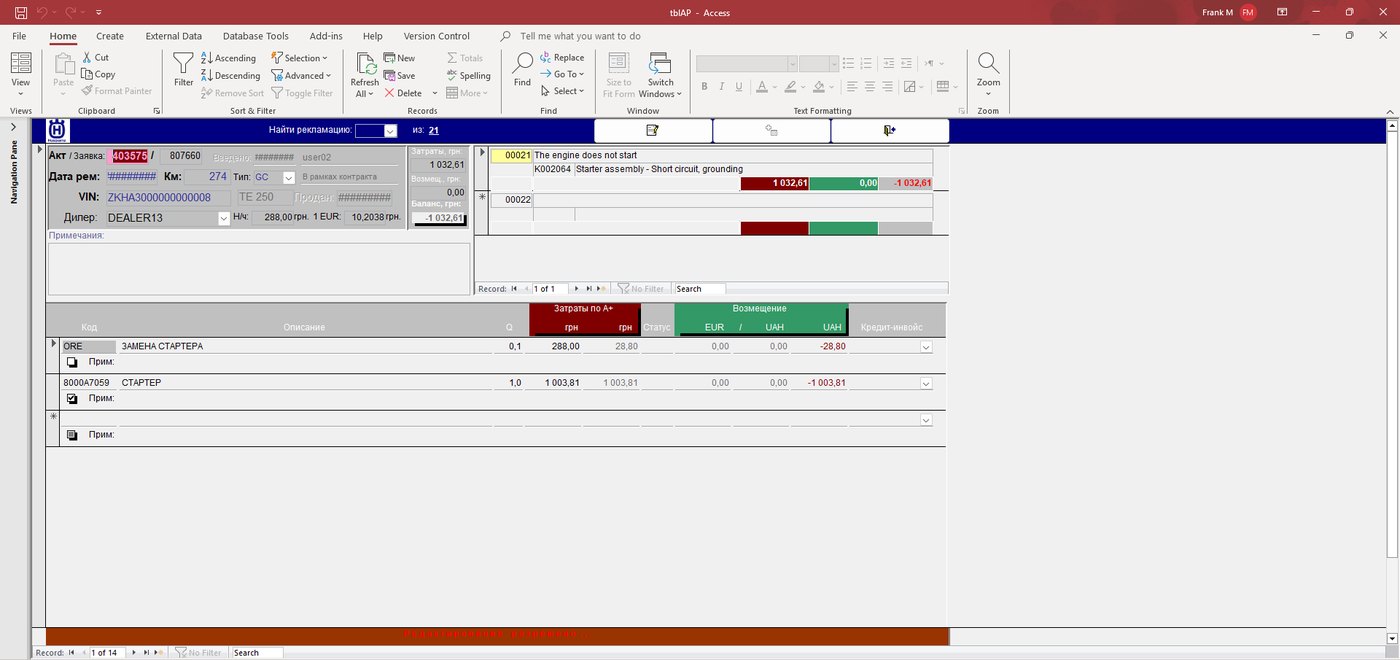
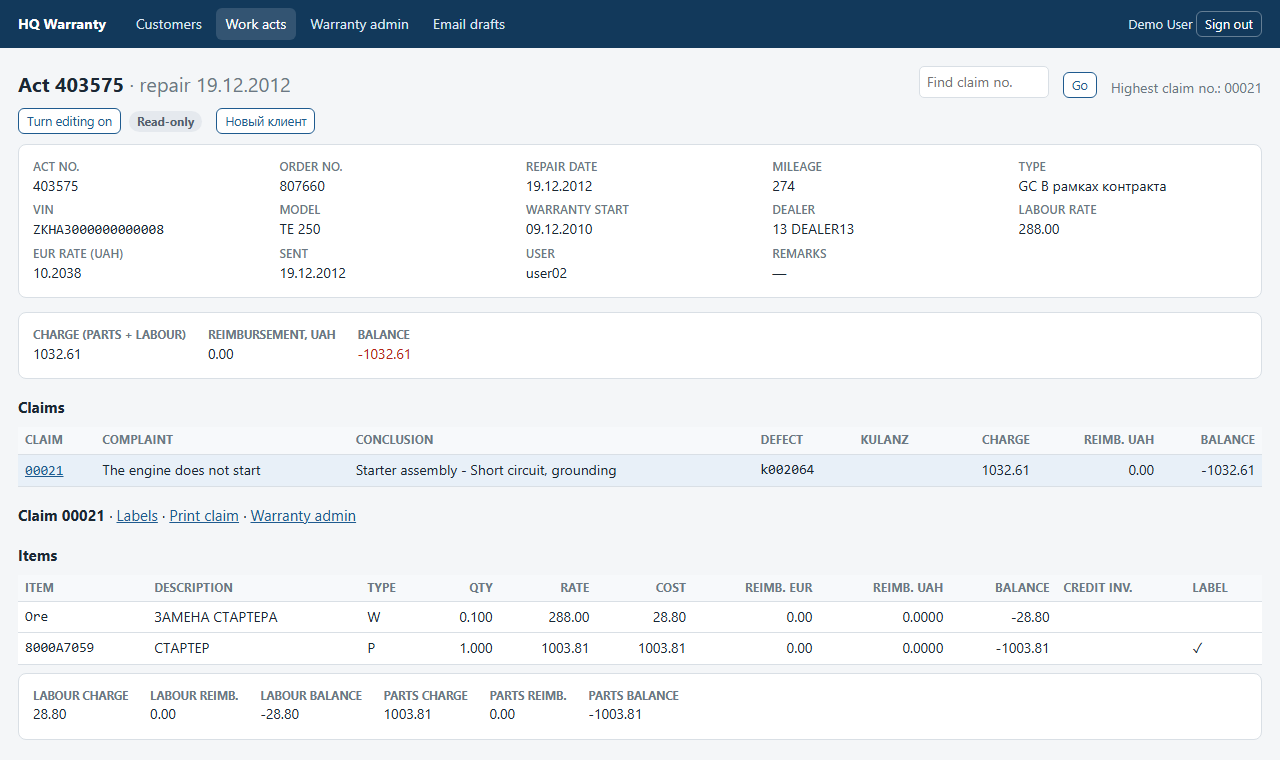
The expected answers weren't written by us. Access itself produced them, by running the original app's own queries, totals and reports on the sample data. The rebuild has to reproduce every one, and the tests were then checked by breaking the rebuild on purpose.
| Results recorded from the original, reproduced by the rebuild | 1,574 / 1,574 |
| Money totals | 133 / 133 |
| Automated tests | 70 pass |
| Defects introduced on purpose, caught by the tests | 16 / 16 |
| Original re-recorded after a restart | identical |
A technical demonstration: nobody commissioned it, nobody uses the rebuild, and it isn't deployed. How the screens compare visually, and use by a team, aren't tested. What is and isn't verified
The danger isn't the app's age. It's that nobody can safely change it.
These apps keep running until something around them changes: a person leaves, a PC is replaced, or an Office update lands.
One person knew how it worked
The developer moved on, the business rules live only in the code, and every change is a gamble with live data.
Errors hide in plain sight
In our sample X-ray, warranty tags printed the wrong claim's parts, and the exchange-rate table was a link to a file on the original developer's PC. See the sample.
The platform keeps moving
Microsoft support end dates for the tools these apps were built on:
- Access 2016 & 2019 · Oct 14, 2025
- Access 2021 · Oct 13, 2026
- Visual FoxPro 9 · Jan 13, 2015
- VB6 IDE · Apr 8, 2008
Access itself continues in Microsoft 365 and Access 2024, and the VB6 runtime is still supported on Windows 11, so an old app may keep working for years. The risk is the day it doesn't, with nobody able to fix it. Sources: Microsoft lifecycle pages for Access 2016, Access 2019, Access 2021, Access 2024, Visual FoxPro 9.0 and the VB6 support statement.
Three steps. Stop after any of them.
Each step leaves you with something you keep, whether or not you go on.
Free X-ray
A short risk report on one qualifying app.
- What it does, in plain words
- Each finding classified: confirmed, potential, or a decision for you
- What breaks, and when
- A size and price range, and which path we recommend
Diagnostic
The full blueprint, and a fixed quote.
- The business rules we identify, with dependencies and exceptions, for you to approve
- Each defect, with a keep-or-fix decision
- Acceptance tests, a timeline and a fixed price
Rebuild
Your app, rebuilt and accepted.
- A modern web app on a standard database
- Passes the acceptance tests you approved
- Two weeks side by side, then switch
How the prices work. Rebuilds start at $6,000 for smaller applications. Your diagnostic establishes the full scope, timeline and fixed price before implementation begins, and any change after that is priced in writing before work starts. The diagnostic fee is credited in full against the rebuild if you sign within 90 days of receiving the diagnostic. After launch there's an optional care plan from $250 a month: managed hosting, backups, updates, and up to 2 hours of changes a month. Unused hours don't roll over, and anything larger is quoted and approved separately. Full terms are in each project's written agreement.
You pay the last 40% only when it passes the tests you approved.
- Before we build, you approve the acceptance matrix: the rules we've identified, the scenarios recorded from your old app, and the results the new one must reproduce.
- Each known defect is listed with a keep-or-fix decision. You make each call.
- We run every scenario against the new app. Every agreed result must match.
- If it doesn't pass, the final 40% isn't due. What happens next, a fix period and how either side can end the project, is set out in the written agreement.
Passing means passing the matrix you signed. We don't claim the new app matches the old one in situations nobody tested. Rules that live outside the app, such as other databases, scheduled jobs or systems we can't access, are listed as dependencies rather than guaranteed.
| Check | Old app | New app | Result |
|---|---|---|---|
| Claim 21 total | 1,032.61 | 1,032.61 | ✓ match |
| Claim 3 reimbursement | 292.69 | 292.69 | ✓ match |
| Item "0" typed on a line | labour line | labour line | ✓ match |
| Warranty labels | claim 15's parts | the open claim's | ✓ fixed |
A safe partner for the app you can't fix.
The first call about one of these apps usually goes to the company that runs the client's IT, so that's who we're built to work with. How partnering works →
We never take your client
We don't sell IT services. We work white-label or co-branded, whichever you prefer.
15% referral
15% of the net fees we collect on every job you refer, including the diagnostic. Paid monthly. Terms
Overflow capacity
Already sell migrations? Hand us the ones you don't want to staff, at a fixed price.
What you keep, and how we handle what you send.
An app copy often contains customer records. Here's how we treat it. Where every copy lives is listed in our privacy notice.
You own the resultYour data is always yours. Once the final payment is made, so is the rebuilt app's source code: you get the code, the database and instructions to run it. Our pre-existing tools are excluded, and third-party components stay under their own licences.
Your infrastructure by defaultThe new app runs on your own or your IT provider's server or cloud account. Managed hosting under the care plan is optional.
Always a way backYour old app stays untouched and in use until you accept the new one.
NDA first, no email attachmentsIf you'd like an NDA, we sign it before you send anything. Files come through a private upload link, never by email.
A dedicated virtual machineYour app only ever runs inside a dedicated virtual machine. Working copies stay on our own workstation, out of online code repositories and out of our backups.
Anonymised when you want itWe can replace personal data with test values before analysis, then check that the business results haven't changed.
AI-assisted, with your permissionOur method uses AI coding tools (currently Anthropic's Claude) to read and rewrite code. We ask for your written OK before any of your material goes to an AI provider, and we can work from an anonymised copy of your data. What a provider keeps is governed by its terms, not ours.
Deleted after the projectWithin 30 days of the project closing, we delete every copy we hold, or sooner if you ask. There are no backup copies to expire. We can't delete what an AI provider has already processed, which is why we ask first.
Founded by an enterprise software engineer.
Frank Martin brings about six years of experience developing and modernizing enterprise software, including API modernization and database migration projects. He holds a master's degree in computer science and a bachelor's degree in mathematics. Legacy X-ray applies that experience to smaller businesses whose critical applications have become difficult to maintain.
Based in Milwaukee, Wisconsin. You deal with Frank directly, from the first email to handover. Frank on LinkedIn

How the work gets done
Every project follows the same method: extract the real app, catalogue each business rule, record what the old app actually does, rebuild, then test the two against each other.
AI tools speed up the reading and writing. A finding only goes in a report once it's confirmed in the database file itself, not just in the code. In the sample, that check removed two false alarms before they reached the report.
Before you send anything.
The questions owners and IT providers ask first.
What's in the free X-ray?
A short risk report on one app: what it does in plain words; the defects we find, each classified as confirmed (reproduced, consequence shown), potential (present, impact not reproduced) or a decision for you; what breaks and when; and a size and price range with our recommended path. The sample shows the format.
It isn't a fixed quote. The fixed price comes from the diagnostic, once you've approved the rule catalogue.
How fast is the free X-ray, and what qualifies?
You get it two business days after we accept your submission, which means we've confirmed in writing that it qualifies and that we can open it.
A free X-ray covers one Access app: one front-end file that still contains its source code (not only a compiled .accde or .mde), its data or back-end file, and any linked files, up to about 20 forms and reports in total. Bigger apps get a quoted assessment instead.
We take on a limited number of free X-rays each week, so we'll tell you whether we can take yours, and roughly when, before you send any files.
Could we repair the app instead of replacing it?
Often, yes. The X-ray recommends one of three paths, and says so when a rebuild isn't worth it:
- Repair: fix the defects that put money or data at risk, in the app you already have.
- In stages: move the data to a proper database server first, then replace screens one at a time.
- Rebuild: a new web app, accepted against your old app's behaviour.
Repair and staged work are quoted after the X-ray. The acceptance guarantee covers full rebuilds.
What does "gives the same answers" actually mean?
It means passing an acceptance matrix you approve before we build: the business rules, the scenarios recorded from your old app, and the results the new app must reproduce.
Copying the old app blindly would copy its bugs too, so each known defect gets a keep-or-fix decision from you. We don't claim the new app matches the old one in situations nobody tested. That's why the matrix is agreed up front.
Will you find every business rule?
Nobody can honestly promise that for an app they've never seen. Rules can live outside the app: in other databases, scheduled jobs, spreadsheets, or systems we can't access.
The diagnostic gives you a catalogue of the rules we identify, plus the dependencies and exceptions we find, and you approve it before we build. The guarantee covers that approved acceptance matrix.
Is the price really fixed?
Yes, for the scope you sign after the diagnostic. If you want something added or changed after that, we write it up as a change request with its own price, and nothing changes until you approve it.
Rebuilds start at $6,000 for smaller applications. The $1,500 diagnostic is credited in full if you sign the rebuild within 90 days of receiving it.
Do you need our live data?
We need a copy, not access to your live system. If it holds sensitive records, we can work from a copy with personal data replaced by test values, or with the sensitive tables emptied. Tell us which before you send it. Nothing goes to an AI provider without your written OK.
Who owns the rebuilt app?
You do, once the final payment is made: the source code, the database, and instructions to run it, whether or not we host it. Our pre-existing tools are excluded, and third-party components stay under their own licences.
Do you handle VB6 and FoxPro?
Case by case. Our tooling and published sample are for Microsoft Access. VB6 and FoxPro apps go through the same method, and after a first look we'll tell you, before the X-ray, whether we can take yours on.
What do you rebuild it in?
By default, a web app written in Python (Django) on a PostgreSQL database. It runs in a browser, so nobody installs anything. If your IT provider needs a different platform, raise it in the X-ray call.
We already have an IT provider. Does this step on their toes?
No. We don't sell IT services, hardware or licences, and we're glad to work through your provider. How we work with IT providers.
What does the care plan include?
From $250 a month after launch: managed hosting, backups, updates, and up to 2 hours of changes a month. Unused hours don't roll over, and anything larger is quoted and approved separately. It's optional: by default the app runs on your own infrastructure.
Tell us about the app.
Please don't attach your database here. If we can help, we'll send a private upload link.
- We reply within one business dayto say whether we can take it on. If we can, you get a private upload link, and an NDA first if you'd like one.
- Your X-ray, two business days after we accept the submissioncovering what the app does, what breaks and when, and a size and price range. One qualifying app per free X-ray (what qualifies).
- A 20-minute callto walk you through it. No obligation.
Thanks. We have your request.
You'll hear from [email protected] within one business day.
Please don't email your database. If we can help, we'll send a private upload link.